


55: I hate crabbing
Crabbing is a side-winding movement of a dog...moving in a diagonal path; moving like a crab. Without intervention, the dog cannot move in a straight line but rather in a diagonal path. The professional handler will pull the dog forcing him to move in a straight line. In turn, the dog will try to pull away from the handler in order to do his natural gait. Another way that a professional handler will try to hide this fault is by not walking in a straight line hoping that the judge will not notice.
CORRECT STRAIGHT MOVEMENT
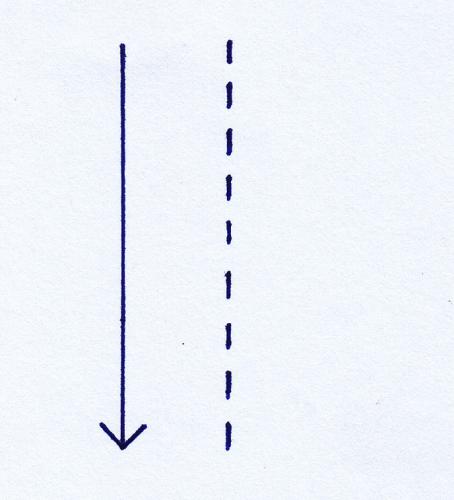
CRABBING MOVEMENT WITHOUT A HANDER
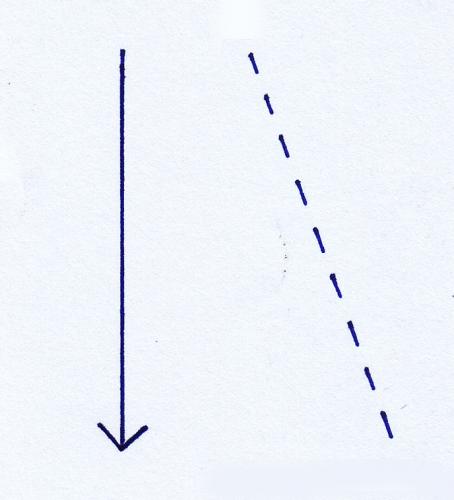
CRABBING MOVEMENT WITH A PROFESSIONAL HANDLER
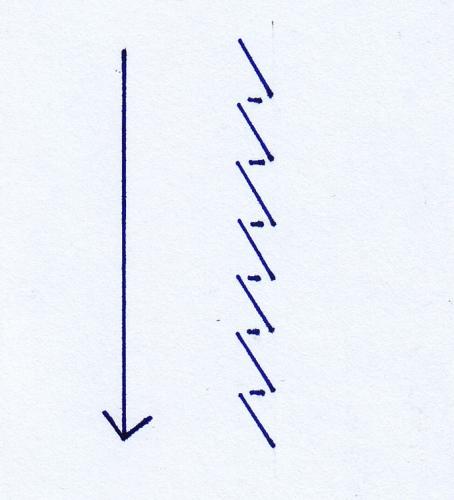
I recall that my very first Pomeranian, Jap Ch Secret Dandy of Azalea Sally, who was a record breaker in BIS in the Philippine dog show history had a crabbing movement. Unfortunately, many international top winning Pomeranians today have this defective UNSOUND movement. It is so frustrating that I would fall in love with a Pomeranian in the show ring at the APC Nationals only to get miserably disappointed when he starts moving....and they win! Is it possible that the judges do not notice this...or do they merely turn a blind eye since they rationalize that since the Pomeranian is this is just a toy dog, it does not really have to move correctly(as long as it moves proudly)? It is very unfortunate that many judges turn a blind eye on this UNSOUNDNESS. Crabbing is essentially unsoundness, like cowhocked rears. Whether it be in a Pomeranian or another breed, crabbing is UNSOUNDNESS.
Below is a video clip from You-Tube of a crabbing dog without a handler. Notice, the dog walks diagonally and cannot move in a straight line. I repeat, if he were to be handled by a professional handler, the handler will force the dog to walk in a straight line and you can still see the dog is pulling away from the handler and not walking normally. OR, the handler will pretend to walk leisurely not in a straight line so that the blame does not go to the dog.
From my own observation and research, a Pomeranian will crab based on the reasons I stated in my EMAIL query below to various friends/judges. Their email responses follow:
My query: (11/22/09)
... Proper engineering of the dog is required to make it move well. Right now, in the US, Thailand and even Philippine Show Ring, there are a lot of Pomeranian specials that move like a crab; ie, crabbing or side-winding. A dog that crabs or side-winds is not sound. This is also very common in other breeds like the miniature pinschers. My question is why do they move the way they do?
I am of the opinion that they do this because:
1. Not enough rear angulation
2. Body is too short such that the front and rear legs hits each other forcing them to side wind
3. The movement coordination of the front and rear legs are incorrect.
4. The front and rear legs is not equally strong and not in equilibrium such that this imbalance makes them side-wind.
5 Too much rear angulation in relation to a straight front shoulders making the rear very strong in relation to a straight shoulders; same rears on a upright shoulder will not cause the crabbing.
I am seeking your expertise in dog anatomy and therefore your valuable comment will be appreciated.
+++
Response from All Breed Judge Ronnie Natividad(Philippines)
I think that your points of observation all contribute with this problem, however I would tend to give more weight on observation #4 plus adding the possibility or fact that the specimen lacks front or rear angulation or both.
+++
Response from All Breed Judge Keven Harris(Australia/Philippines)
THE DOG IN ACTION: A view on crabbing and its causes
Not only is this the title of a very good book by McDowell Lyons, I am temporarily borrowing it to head this piece on movement and in particular that which is often described as crabbing, or, the hind quarter moving outside the line of travel compared to the forequarter action.
There are several theories as to why this inefficient and faulty action occurs and whatever I write here will be just another opinion based purely on the learning I have gleaned over almost 50 years of breeding show dogs.
First, the AKC Standard describes the Pomeranian as being slightly shorter than the height or if you prefer, higher than long. Moreover, the dog is divided equally in height 50/50 brisket-ground, brisket to withers highest point. These would be the first points to consider when seeking in an answer to why crabbing occurs on occasions in this breed.
Another consideration might include the description of the angulation of the quarters which at best is devoid of any real commitment to just what angles are required albeit that the forequarter is asked to be of sufficient layback while the hindquarter gets three mentions of (1 in gait,) strong drive, (2) angulation to match that of the forequarters, (3) stifle moderately bent and clearly defined. Which is it to be one might ask!!
There is in all the text books the premise’ that such a vertical rectangle is now out of balance (the Basenji not so because of the air under the dog) and this coupled with a slightly deeper brisket and an excess of angulation in the hindquarter is the pre-curser to the onset of action that is not only out of balance but also out of alignment, ie; crabbing.
Tom Horner in his book “Take Them Round, Please” says of a crabbing action, “…usually does so because it’s legs are to long for it’s body…”, “…such a dog is out of balance with a marked loss of drive and is decidedly faulty..”
Now here lays a dilemma, as one must decide if the legs are too long or whether the body is too short!!!
“Structure and Terminology”, written by Edward Gilbert Jr, and Thelma Brown, is based on the original work by the late Curtis M Brown and his wife. All three, celebrated dog people and dog writers in their own right, have this to say about crabbing.
“Whenever short body breeds (note, does not say square) go at a fast trotting rate, the feet MUST over reach one another other…” “…because of longer strides, many dogs have the rear paw move either inside or outside of the front paw…” And later, talking about the GSD, “…such action is not faulty, unless the locomotion is crabwise with the dog’s body sideways, out of the normal straight line.
Here is the rub, the GSD is by comparison, a horizontal rectangle (longer body length than high) as opposed to the Pomeranian and still there is a possibility for crabbing to occur especially at a faster trot. Why?? This is a breed that can be much in excess in angulation of the hindquarter and it is this that is the primary cause of crabbing in this and other similar built breeds. The hind legs have nowhere to go except to strike the forelegs or take an evasive line of travel away from straight ahead.
This gives rise the adage of well angulated does not mean the more the better! A small amount of arsenic can be life saving medicine, a lot is poison!
McDowell Lyons, “The Dog In Action” has long been the Bible on Canine Anatomy and while others listed do not entirely agree with his writing, especially Tom Horner, he nevertheless has this to offer on crabbing.
Talking on the stifle, he writes, “…The well bent stifle is as important to the rest, ie; as to the thigh for it means a long second thigh (tibia and fibula) those bones running down to the hock joint, which provides a long Achilles tendon and it’s muscle which activates the hock joint…”
He also goes on to say that most successful horse trainers select their yearling stock based on the length of the tibia, (second thigh) width of the gaskin, hock joint and the shortness of the cannon bone to the ground.
You may have noticed when I judge that it is and area that I always place my hands on so as to gauge the value of the overall hindquarter.
He further states that, “…an overreach of the back pad mark beyond the front indicates short coupling, stiltedness and straight shoulder blades coupled with a rear hand too well angulated for the forehand…”..
“Summarizing, we can say that a good traveler puts the pads on or near the line of progress and keeps all four in planes which parallel this line”.
So Basilio, given all these points and having read these books and others over and over for almost 50 years, having never bred or owned an adult dog with this problem and using simple logic, I conclude that there are many issues that bring about the crabbing gait.
It is a fact for me at least, that in very young stock it can manifest itself, later becoming non existent with maturity, one main reason why I rarely showed dogs before 9-10 months of age.
The solution to hasten correction was always several short walks against boundary fences on the wrong side on a very short controlled lead.
There is no doubt for me that too short a back, too much hind angulation, short stepping front assemblies and the lack of balance between each can conjure up are the real cause of crabbing either separately or collectively.
Note that the last mentioned author states with out actually saying it that the hind quarter anulation can be correct, but striving to cope with incorrect forehand angles, a situation I totally agree with and occurs in several breeds.
I know it is a long piece however I don’t think it would be worth writing about without all the supporting evidence.
+++
Response from Dr Raymundo Lo(Multiple Group Judge)
You'll have to check the chest proportions. Oftentimes, the chest is too narrow with the result that the shoulder assembly tucks in and you will see the legs too close together. Add loose shoulders and you'll have all sorts of wrong movements.
Too short bodies produce the typical Pom movement- rather bouncy short steps but should not influence the front gait.
Extreme rear angulation should not affect front movement other than drive it faster. The other extreme- produces poor drive.
+++
I am in the process of re-doing my website and you will see my new website with a section from experts and friends who can share some of their valuation knowledge with by blog readers.
May 29, 2011
............................................................................................................................................................


 are LUCKY...
 are SWEET...
 are EXOTIC...
 are MAGICAL...


Comments
Comments only. For inquiries, click here.
It very attractive how detailed outcome on apprehension case has been well elaborated here within this blog. Please keep it up. we adore it. I know that you are a well-recognized and honored source on the Internet and I will use this for my buy research paper needs. Thanks.
Ignoring the fact that even front paws add to drive or push the dog forward...if we could visualize the dog as a normal car where the front tyres give direction and the rear tyres push or drive, we could better explain this problem. The front is moving out of the way of the overangulated hind in case of dogs of normal length or in case of oversquare dogs there is not length for normal front and normal hind to move independently without hitting..usually oversquare dogs would have steep shoulders but the length of the tybia and angulation of the pelvis is independent of shoulders..it will give problems.
I have been exploring for a little for any high
quality articles or blog posts in this kind of area
. Exploring in Yahoo I at last stumbled upon this site.
Studying this info So i'm glad to convey that I've a very good uncanny feeling I discovered ust what I needed.
I most for sure will make certain to do not put out of your
mind this site and provides it a glajce regularly.
It's in point of fact a nice and helpful piece of info.
I'm happy that you just shared this helpful information with us.
Please stay us up to date like this. Thanks for sharing.
I constantly emailed this webpage post page to all my contacts, because if like to read it next my links will too.
Post new comment